Real life Greenland 'Odyssey' celebrated in documentary
ND’s own Dr. Jon Solberg served as team physician on 1,400 south-to-north crossing
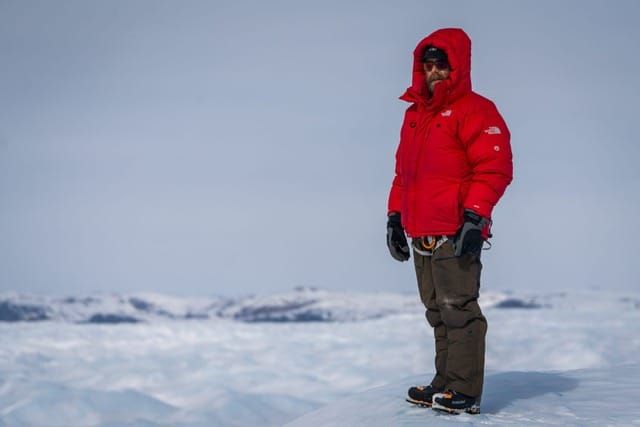
When North Dakota emergency physician Dr. Jon Solberg agreed to be the first to cross Greenland’s ice sheet by vehicle with six other adventurers in 2018, all the lessons he’d learned through life came to bear.
From his earliest midwinter campouts in snow caves near Stanley, North Dakota as a youth, to his medical training at UND, to service as an Army physician in southern Afghanistan, to remote medical work in Africa, to a wilderness medicine course he took learning crevasse and avalanche rescue, each piece was essential.
Yet the biggest challenge, and perhaps the next lesson of his training, was forging bonds with six other strangers to survive for weeks under extreme conditions.
“It was one thing after another after another,” Solberg said. “We had countless setbacks that, just because we were willing to work together, we were able to overcome.”
That meant navigating together through crevasses, blizzards, elevations up to 10,000 feet, temperatures below minus 40 Fahrenheit and repeated equipment failures. Due to the distance between suitable campsites, some driving shifts went as long as 75 hours.
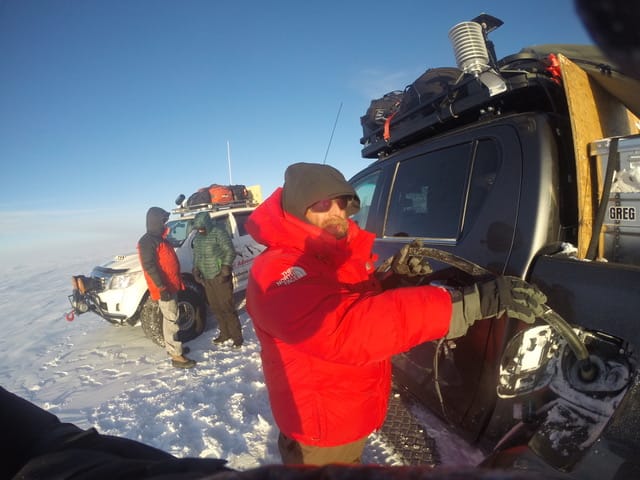
“We were seven strangers locked together in a really small confined area, and we were from all different backgrounds of religion and politics and country, and yet somehow we were all able to get along and have really in-depth discussions about some of these differences, and yet never argue with each other,” Solberg said. “It’s kind of rare.”
Free screenings of the documentary chronicling the trials and travails of the team, “Expedition: Greenland” (2025), followed by Q&As with Dr. Solberg, will be held on Sept. 12 in Bismarck, Sept. 13 in Minot, Oct. 10 in Grand Forks and Oct. 11 in Fargo. The sessions are organized by The Study, formerly Humanities North Dakota.
Brenna Gerhardt, executive director of The Study, drew parallels between the Greenland expedition documentary and the wildly popular epic summer film “The Odyssey,” which, while an adventure story, is “really about character and leadership under pressure,” she said.
“In this documentary, the ice isn’t building character, it’s exposing character that was always already there,” Gerhardt said.
Gerhardt said the importance of documentaries like this, as well as studying history or reading novels and other stories, is how they put us inside the decision-making of others.
While audiences feel the weight of a tale, they don’t pay a direct cost of those decisions, giving them the ability to play out scenarios in their minds.
“It’s the capacity to picture what it's like to be someone other than yourself, and to inhabit their moral decisions, so that you can inform your own,” she said.
Gerhardt said another important aspect to reflect on is the months of preparation it took before the wheels took off across the ice, as well as the lifelong preparation by each participant.
“It is built like any skill is built by doing it repeatedly, by getting guidance, it's about deliberation, and that we need to have that,” she said.
The documentary captures a lot of this, she said, and she is looking forward to how Solberg talks about this in relation to leadership under extreme conditions.
For Solberg, that preparation started several months before the expedition. As the sole physician on the trip, he was responsible for interviewing each potential member to ensure nothing would arise that would put the trip and safety of others in jeopardy.
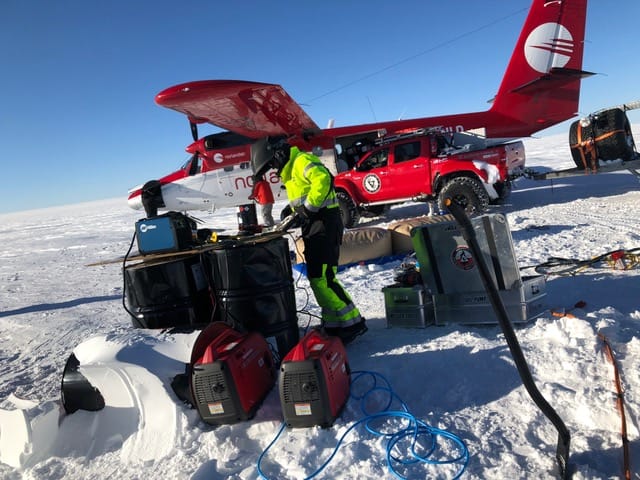
“There were some individuals who were slated to go along that we screened out medically just because we couldn't afford to have something go wrong with their medical conditions,” Solberg said of difficult decisions that started even before the team got boots on the ground.
Solberg monitored the team’s medical preparedness, sleep, sanitation, nutrition and helping keep the team physically and mentally in top shape. Preparation also came with determining what supplies to bring as everything needed to be able to withstand freezing conditions.
Brian Jackson, a podcaster, entrepreneur and founder of Mighty Missouri Coffee, who will moderate the Bismarck and Minot events, said he’s hoping Dr. Solberg will speak about how lifelong bonds and relationships can form through adventures like this.
“So he might talk about this, but I mean, he has every word memorized from a Taylor Swift album because that's what the CD in the vehicle was playing,” Jackson said.
He also said his impressions from having interviewed Dr. Solberg before for his podcast make him feel like Solberg is someone who pursues things outside of his own comfort zone, something he feels is important for all of us to emulate.
“I’m a big believer in mini-adventures, not just to be a weekend warrior, but to look forward to something bigger and to challenge yourself,” Jackson said. “Everything is just gearing toward ease and comfort as a cultural expectation, and it’s not good for us.”
For his part, Solberg said he felt having adventures in life is a wonderful way to pause time and that sometimes the most difficult journeys form the most lasting memories.
“Driving to the tip of Greenland and back is like driving from Bismarck to San Diego and back with no roads and no maps and no gas stations,” Solberg said. “If we'd have gotten on the interstate and stopped at the largest ball of yarn and had a perfect trip, nobody would want to hear about that.”
Support Independent Journalism
Your donation to the North Dakota News Cooperative puts our communities first by delivering in-depth reporting on the issues that matter most.
Donate to NDNCThe North Dakota News Cooperative is a nonprofit news organization providing reliable and independent reporting on issues and events that impact the lives of North Dakotans. The organization increases the public’s access to quality journalism and advances news literacy across the state.
Have a story idea? Send tips to michael@newscoopnd.org. Connect with us on X or Facebook.