Existential questions cloud picture of North Dakota’s place in AI revolution
Concerns increase related jobs, geopolitics, climate, humanity’s future

While North Dakota communities grapple with questions related to the local impact of data centers, a whole series of larger concerns continues to swirl around artificial intelligence.
On their minds are also bigger questions like disruptions to existing jobs, whether it contributes to greenhouse emissions, how to prevent military mishaps between global adversaries, whether AI companies can self-regulate, and risks of superintelligent AI targeting humanity.
Governments and tech leaders across the globe have done little in recent months to calm those fears.
Yet public concerns about economic, local, social, environmental and existential consequences of AI could leave North Dakota on the outside looking in if clear policies are not set at the state and federal level, some say.
“One fact that people need to know is that these data centers are going to be built,” said Robert Mayo, a research specialist at the North Dakota State University Challey Institute of Global Innovation and Growth.
“You cannot stop them. You cannot even slow this down. It is impossible. All you can do is push them from one place to another,” Mayo said.
Mark Hagerott, one of two citizen advisors on the North Dakota Legislative Committee on AI and Data Centers, said having an overarching plan for data center development and how AI is used in the state is needed.
“It would be very helpful because these people don't have experience,” Hagerott said. “The local people now trying to make these complex decisions are not experts. They are our fellow citizens. They are council members.”
Hagerott said the state and local communities should be able to zone and build data centers through transparent processes that include feedback from impacted communities.
“The people of North Dakota are totally correct to ask questions, and sometimes hard questions,” Hagerott said about the data center and AI rollout.
A new revolution
One issue may be coming to an understanding that AI development will have far-reaching impacts in order to better prepare for them.
At the end of September, President Donald Trump said he would never stifle the growth of a technology that “will be bigger than the Industrial Revolution.”
Nobel prizewinner Demis Hassabis, head of Google’s DeepMind, recently told The Guardian it would be 10 times bigger and 10 times faster than the Industrial Revolution, and governments and industry should work to minimize disruption.
Decisions on how to prepare for employment, climate, geopolitical and AI industry disruptions can’t necessarily all be made at the local level, though that doesn’t mean local governments should totally ignore them.
“I think our goal should be to make the transition to this new hardware technology, new economy, the new software, the new way of doing business … make that plan for it, so we can make that transition as smooth as possible and reduce the disruption,” Mayo said.
Mayo recently authored a guide “AI Data Centers: What North Dakota Needs to Know” that details some of the common concerns residents have, as well as how the state could benefit from the AI revolution.

Closer to home many tout the benefits North Dakota has when it comes to developing data centers to power AI rollout.
A mostly cool climate. Plenty of land. Stranded natural gas assets that need a market.
The tremendous productivity of the Bakken is a huge draw for data centers, and with more and more natural gas being produced, the state needs to find something to do with it, said Mayo.
“They need energy. That's a problem for them. We have natural gas we need to get rid of. There are two problems that solve each other,” Mayo said.
Questions abound
That triggers questions further related to how much of an impact the vast buildout will have on an aging electricity grid, how the need for extensive natural gas pipelines impacts farmers and other property owners, and who covers those costs.
On top of that is how increased fossil fuel use will contribute to greenhouse gas emissions. This may not be top of mind in North Dakota, but it is elsewhere.
An Associated Press-NORC Center for Public Affairs Research and the Energy Policy Institute at the University of Chicago poll released on Sept. 16 found 53% of Americans either extremely or very concerned about the environmental impacts of AI data centers, up from 41% who felt that way in 2025.
BloombergNEF, which tracks energy and emissions data, estimates that on-site and dedicated natural-gas power plants for data centers have the potential to add roughly 318 million metric tons of carbon dioxide annually in the next decade, or around 20%, lifting total U.S. power sector emissions by up to a third.
While around 95.5% of North Dakota natural gas is captured before it is flared at Bakken wells, questions remain about the amount of emissions released at the facility level for data centers powered by gas.
On water, currently no statewide estimate of cumulative future water use for data centers exists.
Researchers at the University of Texas estimate that data centers in Texas will consume 9% of that state’s water by 2040, as an example.
Trung Bao Le, interim director of the North Dakota Water Resources Research Institute at NDSU, said his researchers have not had the resources to carry out an extensive study on this, but believes it is important to get studies done if the funding can be found.
Support Independent Journalism
Your donation to the North Dakota News Cooperative puts our communities first by delivering in-depth reporting on the issues that matter most.
Donate to NDNCExistential fears
Recent warnings from some of the top AI and tech leaders - Sam Altman, CEO of OpenAI; Dario Amodei, CEO of Anthropic; and SpaceXAI founder Elon Musk - about the potential for AI agents to go rogue and foment an internet apocalypse if guardrails are not pursued, has also raised alarm.
Geoffrey Irving, formerly of OpenAI and DeepMind and former chief scientist at the U.K. AI Security Institute, writes there’s a 50% chance humanity is wiped out by superintelligent AI and that actions to put safeguards in place must come within the next decade.
Other top AI leaders have voiced similar fears with varying ranges of probability, though it’s not likely something to drop $100 down on Sportsbook.
And while some of the same top tech executives signed on to a “morally binding” document regarding artificial intelligence safety and oversight at the White House at the end of September, it did not include any real enforceable action.
Congress has also been wary about establishing guardrails.
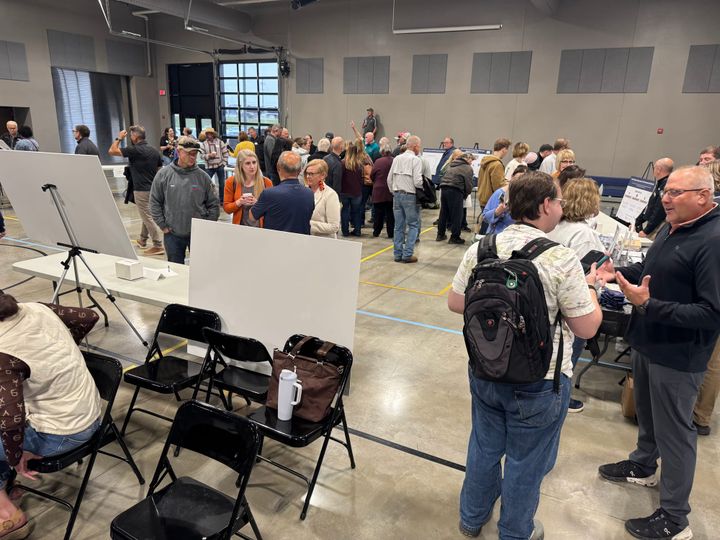
“AI scares me to death, I’ll just say it,” state Senator Mark Enget (R-Powers Lake) told NDNC on the sidelines of a recent data center town hall in Tioga.
The backlash to AI is mounting nationally.
A Marquette University Law School poll at the end of September found 64% of respondents saying they felt AI was bad for society.
How AI, automation and structural shifts will impact employment in North Dakota is another question, and one of the big unknowns going forward.
Across the U.S. around 7% of the country’s labor force may have to change jobs in the coming decade because of AI disruption, management consultant company McKinsey detailed in a report released at the end of September.
Mayo likened some of the job disruption to the Industrial Revolution, saying how horse and buggy manufacturers shut down, but car assembly line jobs opened up.
“Change is hard. It’s disruptive, even if it changes for the better,” Mayo said.
A Pew Research Center poll from mid-August found 71% of adults believing AI will lead to fewer jobs in the U.S. over the next ten years.
Trygve Hammer, Dem-NPL candidate for the U.S. House, told NDNC he’s primarily concerned about where those jobs will go and what is being done to reduce the disruption.
“I think we really don't know what it looks like next, but we need to make it clear now it's not going to be some kind of techno feudalism where we’ve got the AI chiefs in their castles and the rest of us are serfs on the outside,” Hammer said.
AI arms race
On top of that, geopolitical issues give some pause about slowing down the pace of data center and AI development, with some arguing that the U.S. is in an AI arms race with countries like China.
They say decelerating unilaterally would cede global competitors an advantage unless there’s a global agreement, similar to Cold War-era arms treaties.
This latter point related to competition with China has been the Trump administration’s most recent pushback against any slowdown in AI development.
“We’ve still got to keep ahead of the Chinese,” said Divide County resident Mike Smith at the recent Tioga town hall. “It’s kind of like the arms race. So it’s kind of a double-edged sword.”
Hagerott said that if the U.S. is in an arms race, it shouldn’t be the duty of the people of North Dakota to provide data centers for the U.S. military, and that the federal government should cover any risks associated with larger-scale data centers.
Essentially that means covering any costs related to those projects, removing local concerns about long-term impacts.
“With data centers, we should be able to figure it out with transparency, goodwill, win-win,” Hagerott said. “One of the things would be for the government, the federal government, to do, if we are really in an arms race, is assume the bonding and liability for these data centers (above a certain size).”
Support rural news by donating now.
Because we don't receive network funding, our independent journalism relies on supporters like you.
Donate to NDNCThe North Dakota News Cooperative is a nonprofit news organization providing reliable and independent reporting on issues and events that impact the lives of North Dakotans. The organization increases the public’s access to quality journalism and advances news literacy across the state.
Have a story idea? Send tips to michael@newscoopnd.org. Connect with us on X or Facebook.