
New food guidelines take a bite out of public schools
Schools may scramble to measure up
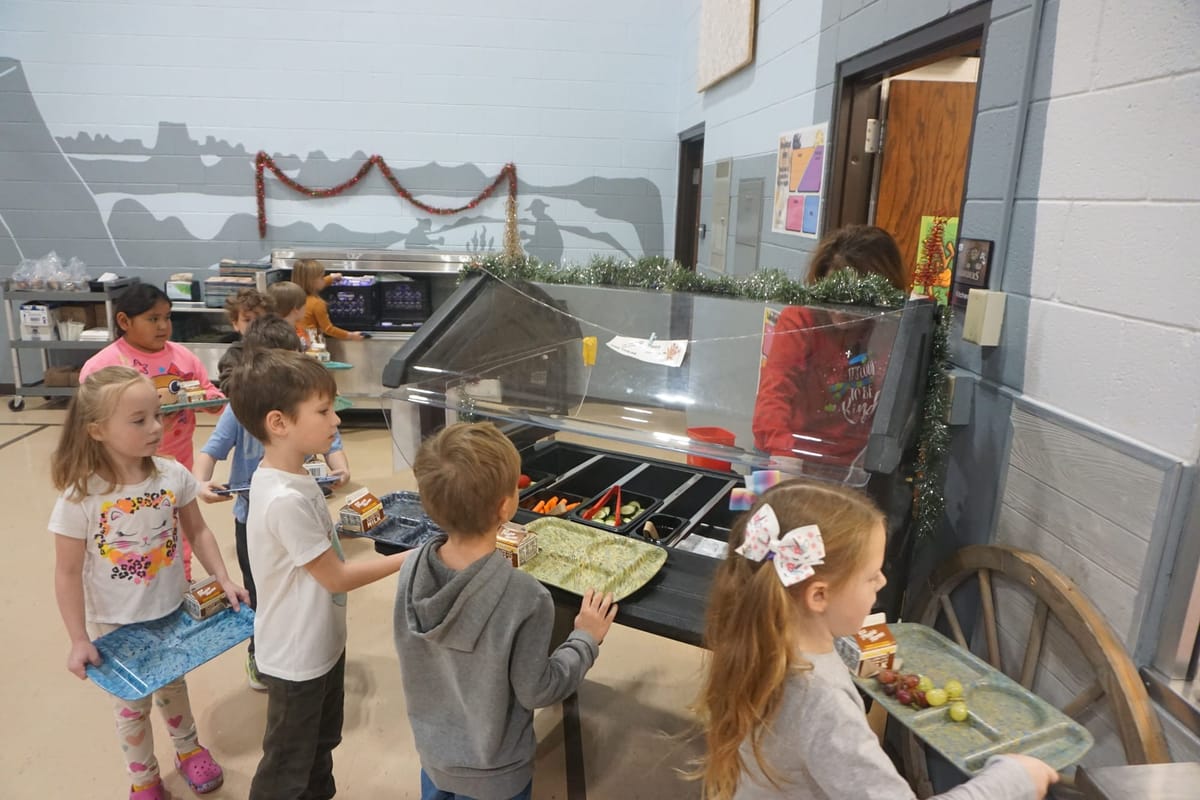
New federal efforts to limit processed food and encourage the consumption of whole foods will impact school budgets, staffing and menu options for K-12 kids over the coming years across North Dakota.
Some policies, like reducing the amount of sugar, are already being rolled out, while longer-term goals for increasing protein and healthy fats are expected in the near future.
While the aim of the new guidelines is to improve the overall health of Americans who follow them, any programs getting federal assistance are the only ones required by law to adopt. That includes K-12 students, military, childcare, hospitals and others.
One of the biggest challenges will be the shift away from entrenched eating patterns developed over the past four-odd decades. Those habits became reliant on cheaper, convenient and often heavily processed food packed with sugars and carbohydrates.
This abrupt shift away from carbohydrates and the food systems built to support them will likely lead to increased costs due to challenges of changing supply chains, a need for upping staff numbers, and retrofitting kitchens to boost their ability to make more whole foods on site.
Lynelle Johnson, state director of child nutrition and food distribution at the Department of Public Instruction, said it will likely take some time for the latest changes to impact K-12 schools, but those changes are coming.
“They did say this would be expedited,” Johnson said of the new rules.
Schools across the state are currently implementing limits on added sugars in products like milk, cereal and yogurt, stemming from the 2020-2025 guidelines, with those expected to be finalized by the end of this year.
Requirements that limit sugar to no more than 10% of calories in a weekly school menu, as well as reductions in overall sodium content, are next and set to be implemented through the end of 2028.
The U.S. Department of Agriculture sets the Child Nutrition Program guidelines based on the latest Food and Drug Administration dietary guidelines but has provided schools little direction on compliance.
“USDA has given us zero guidance on how we're going to monitor this,” Johnson said. “How we're going to review that is unknown.”
Companies are leading the charge in the changes she said, reformulating their products so they can still sell to schools and other institutions.
“If you see Trix or Cocoa Puffs in a school, that is a specially formulated cereal for school,” Johnson said. “If you see it in the grocery store, compared to what’s in a school, they’re not the same. Even a Ritz cracker in a school is whole grain, where in a grocery store it is not.”
The changes have taxed supply chains, she said.
“Manufacturers have said, if you mess with this too much, we’re out of K-12 (food), we’re done.”

A brief history
Before the most recent guidelines announced in early January by Department of Health and Human Services Secretary Robert F. Kennedy and USDA Secretary Brooke Rollins, nine other iterations were developed starting from 1980.
By the 1990s, the “Food Pyramid” recommended around 6-11 servings of carbohydrates from bread, cereal, rice and pasta to form the base, with fruits (2-4) and vegetables (3-5) in the middle, followed by dairy (2-3), plus meats or other proteins (2-3) toward the narrow top. Oils and fats were recommended only sparingly.
The latest pyramid flipped to almost the exact opposite of that 1990 version.
Protein - now recommended at about double the previous Food and Drug Administration guideline - dairy and healthy fats, along with vegetables and fruits, form the largest portion of recommended caloric intake.
Carbohydrates from whole grains are now relegated to the narrowest section at 2-4 servings per day.

A major shift
Jennifer Hehn, food service director at Lisbon Public School District, said the move away from processed food makes a lot of sense.
“It represents how me and my family eat and I think how a lot of families eat,” Hehn said of the new guidelines. “We shouldn’t be eating so much processed foods, and I think we have a lot of health issues because of all the processed foods.”
While bigger changes likely won’t come fast, the challenges will eventually mount.
“We’re a small community,” Hehn said. “The biggest challengers are going to be staffing, budget and equipment for these new guidelines.”
Most schools do not have large kitchens nor the ability to cook whole foods from scratch on site, if that is eventually the end goal.
Without funding for more staff, more equipment and larger kitchens, those constraints may limit the ability to deliver what the guidelines aim for.
Schools will need bigger kitchens and bigger staff sizes if a fundamental shift in school nutrition is expected to be made, Johnson said.
Current federal reimbursement rates for free school lunches currently stand at $4.69 per meal. Around $1.50-$2.00 of that goes to just covering labor costs, she said.
“I'm all for not eating processed foods,” Johnson said. “But when you think about it, if you have an elementary school with 400 kids, and you've got to serve them in 20 minutes at 11 a.m., and you have to do all that for $4 per kid, that’s the position that schools are in.”
Johnson gave an example of using whole potatoes rather than highly processed instant potatoes that include preservatives, stabilizers and other additives not in the whole food potato they are derived from.
“Who’s going to peel and boil those potatoes?” she asked. “When I say these things, I sound like I'm advocating for processed foods. I’m not, I'm just talking about the reality of the situation.”
Anything requiring more whole foods would likely mean adding more staff, Hehn said.
Even procuring locally for scratch cooking can be a challenge.
Hehn said her district was able to bring in a lot of local ground beef this year but is trying to get funding for a tilt skillet that would allow for better cooking of a raw protein like that.
Freezer and cooler space would also likely need to be increased if more whole foods and cooking on site is required, she said.
Michelle Wagner, child nutrition program director at Bismarck Public Schools, said costs have “definitely gone up” due to manufacturers having to reformulate products to meet the last guidelines focused on reducing sugar, sodium and increasing the use of whole grains.
Wagner also said the complexity of the guidelines and keeping within the parameters makes it harder to do more cooking from scratch.
“Does this count for two meats and two grains? Does this count for, you know, half a cup of vegetables?” she said of the questions she has to ask. “Do we have to add a breadstick? Do we need to take something out because we’re over our calories now?”
Schools processing raw beef would also need grease traps, and most don’t have those, Wagner said.
Wagner uses a nutritional analysis program that helps, but even things like ranch dressing, ketchup and other condiments have to be factored in, largely because of their higher sugar and sodium content.
Schools also need to meet minimum and maximum calorie requirements for each day and for each week, as well as meet vegetable subgroup categories throughout the week.
“You have to offer five components, and out of all the vegetables, you’ve got to hit all these vegetable subgroups within a week,” Hehn said. “It's like a big puzzle.”
Additional increases for protein likely to come from the latest guidelines could also be an issue.
“That’s obviously going to be our highest cost item,” Wagner said. “Who’s going to pay for that? Is the federal government going to give us higher reimbursement rates to cover that cost?”
Wagner said Bismarck schools are currently looking at the possibility of a central kitchen, which would decrease labor costs and increase efficiency.

The North Dakota News Cooperative is a nonprofit news organization providing reliable and independent reporting on issues and events that impact the lives of North Dakotans. The organization increases the public’s access to quality journalism and advances news literacy across the state. For more information about NDNC or to make a charitable contribution, please visit newscoopnd.org. Send comments, suggestions or tips to michael@newscoopnd.org. Follow us on Twitter: https://twitter.com/NDNewsCoop.