Lost WW2 sailor may finally return to North Dakota
Researcher finds evidence of sailor, investigates 10 other missing ND servicemen
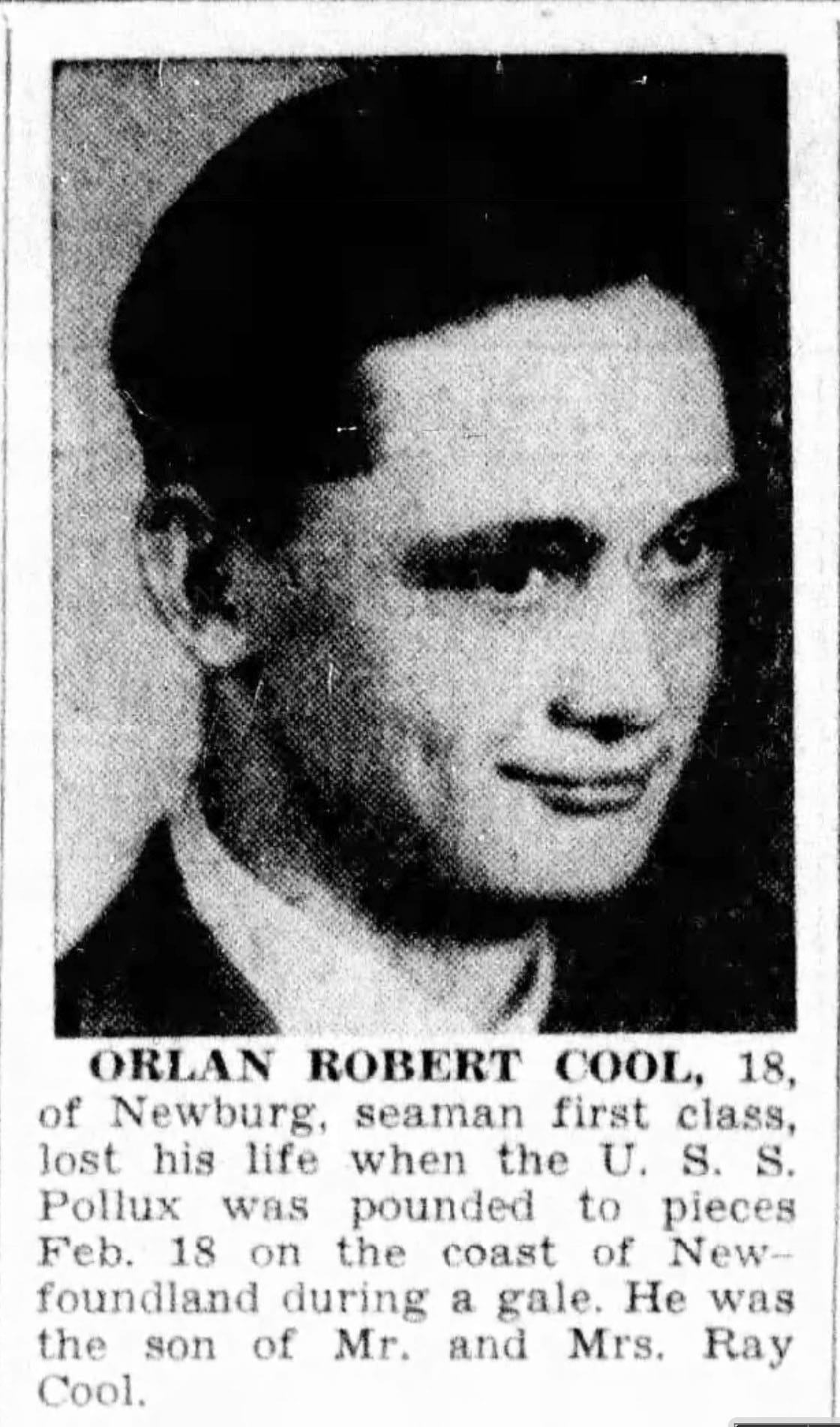
When Orlan Robert Cool went missing after his ship broke apart off Newfoundland’s frozen coast during a freak storm on Feb. 18, 1942, his death was a double tragedy for his family in Newburg, North Dakota.
He became the second son out of four to die. The other two would be dead within two years.
Now there is a glimmer of hope that Orlan’s remains may finally return home.
Retired Marine and Vietnam veteran Ted Darcy, who dedicates his life to researching missing World War II soldiers and sailors from his own father’s war, believes he has located Cool’s remains at Long Island National Cemetery.
“I'm doing my father's war,” Darcy said. “I'll never get to my own.”
Over the past 30 years, Darcy has submitted more than 200 cases to the Defense POW/MIA Accounting Agency (DPAA), with 50 leading to remains being returned home. Cool’s may be one of the next.
“Their families were never told they buried unknowns,” Darcy said of those he connects with through the research. “They’re surprised when they find out.”
The remains of 39 sailors who’d died after the USS Pollux and USS Truxtun sank that day were recovered but not identified. There’s a ring with the initials ORC on it, the only piece of property recovered from one of the bodies.
For years the remains of unknowns recovered from the shipwrecks were buried at Ft. McAndrew on the western side of Newfoundland. They were later moved to the Long Island cemetery.
Darcy has now been able to connect with Gayle Peterson, Cool’s niece who grew up in Newburg and now lives in St. Paul, Minnesota, in hopes of getting the case settled and the remains returned.
Peterson said she’d never heard much about her uncle’s death, not even the name of the ship.
“It wasn’t talked about a whole lot,” Peterson said of family discussion about the death.
What she did know was how devastating the loss was for her grandfather.
Orlan’s father, Ray Cool, lost his youngest son that cold February day. He’d already lost another son in 1937.
Ray signed off on Orlan’s enlistment papers a year before, when he was just 17. Orlan graduated as class valedictorian just before joining the Navy and shipping out to Great Lake Naval Training Station.
“I guess grandpa was pretty upset because he had to sign for Orlan, and so he felt guilty that the boat had gone down,” Peterson said. “Grandpa felt really responsible that he passed away.”
Orlan was presumed lost at sea and his body was never recovered. Or so the family thought at the time.
Compounding the tragedy for the family, two of his older brothers also died within two years of the sinking, one from drowning and another who died in South America. Their bodies were never recovered for burial back home either.
After connecting with Peterson, Darcy found that a DNA sample was collected several years ago from another of Orlan Cool’s relatives.
Murray Sagsveen, attorney for the Western North Dakota Synod ELCA, who documents rural cemeteries in the state, was able to connect with Dovre Lutheran congregation in Newburg regarding Darcy’s interest in locating a relative.
Lisa Plorin, during Sunday services in Newburg in January, passed a message to parishioners about Darcy’s research. Judy Hunskor, a friend of Peterson’s in attendance, passed the information to her about Darcy’s work.
“It would be awesome if everything works out for the family,” Plorin said.

Darcy has contacted the DPAA and is waiting to hear if the case will move forward.
He said both the wrecks off Newfoundland and another in New York harbor were batched together to be investigated, but work never went forward after DNA samples were collected.
The DPAA likes to conduct group investigations because it is more efficient, Darcy said, but he is hoping they move more quickly on Cool’s case as well as others he’s recently come across.
It may be easier to process the case since the deceased were buried individually, and not as a group, he said.
“I would really like to go forward with this,” Peterson said. “And give him a proper burial.”
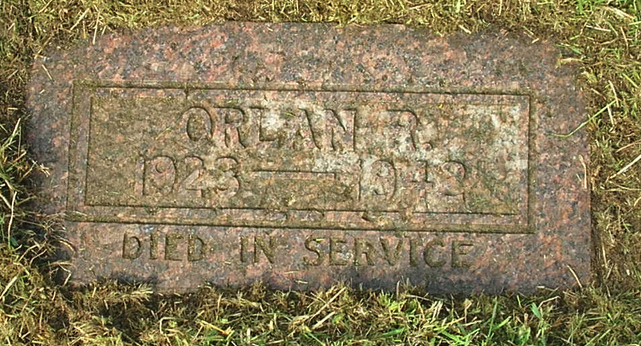
Back in Newburg, an empty gravesite at Dovre Lutheran Cemetery with Orlan’s name on the stone lies near the graves of his father and mother.
A total of 203 seamen perished in the wrecks of the Pollux and Truxtun, while 186 survived.
The last known survivor of the Pollux, Lanier Phillips, died in 2012.
Phillips, the grandson of slaves, served as a mess attendant on the ship due to segregation policies in the Navy at the time. Years after the war he became a civil rights activist, joining Martin Luther King Jr.'s 1965 march from Selma to Montgomery, Alabama.
Darcy maintains a database of over 17,000 MIAs from WWII; 340 of those are from North Dakota. He’s currently attempting to identify another 10 from North Dakota who went missing in action during the war, and hopes relatives step forward if they recognize names.
Once they do, they can request a DNA kit from the DPAA to start the process of identification and potentially get the remains returned to North Dakota, though procedures can take several years.
One such case is U.S. Army Air Forces Staff Sgt. Irvin C. Ellingson, of Dahlen, North Dakota, whose remains were formally accounted for in June of 2025.
Ellingson was shot down over Japan in April 1945 and taken as a prisoner to the Tokyo Military Prison, where he died in a catastrophic fire the following month. The fire killed over 100 American POWs.
Remains of nearly three dozen of those POWs were examined in 2022, with Ellingson positively identified in that batch.
Ellingson will be buried in Dahlen on June 20, 2026.
The 10 from North Dakota Darcy is investigating include: Carrol L. Carlson of Bismarck, lost during the Palau campaign in the South Pacific; Normand J. Montplaisir of Horace, Melvin L. Nicholson of Bowesmont, and Arnt G. Odegaard of Tioga, all lost during kamikaze strikes in Okinawa; John T. Opsvig of Ward County, stationed in Sichuan but lost during China operations near present day Wuhan; Carrol N. Osterdahl of Ransom County, lost during operations in Malaysia; Arnold A. Pfaff of Sheridan County, lost in Ottre, Belgium; Aldrich A. Seeley of Cavalier County, lost at Neuenkirchen, Germany; Eldred W. Stafney of Burleigh County, lost at Haiphong, Vietnam (French Indochina at the time); and George A. Swenson of Ward County, lost off of Chieuti on the east coast of mainland Italy.
Families can contact Darcy at: teddarcy@yahoo.com or through the website at: http://wfirg.com/
Sagsveen said the list itself tells a story.
“Young men from every corner of North Dakota were deployed to serve and die in every corner of the globe,” Sagsveen said. “The ranks indicate they were junior commissioned and noncommissioned officers, likely leading small units into battle.”
Support independent journalism that puts North Dakota’s communities first. Your donation to the North Dakota News Cooperative helps us deliver in-depth reporting on the issues that matter most.
The North Dakota News Cooperative is a nonprofit news organization providing reliable and independent reporting on issues and events that impact the lives of North Dakotans. The organization increases the public’s access to quality journalism and advances news literacy across the state. For more information about NDNC or to make a charitable contribution, please visit newscoopnd.org. Send comments, suggestions or tips to michael@newscoopnd.org. Follow us on Twitter: https://twitter.com/NDNewsCoop.