Poll: Young North Dakotans lead AI usage, but fear economic toll
Majority fear AI a long-term threat to human civilization
North Dakotans fear advanced artificial intelligence will eliminate more jobs than it creates in the state over the next decade, with younger respondents leading the way in those concerns, the latest North Dakota Poll finds.
Young adults are the heaviest users of AI, with 42% of 18- to 34-year olds reporting daily or weekly use, but they are also the most distressed that AI could displace jobs, according to the poll.
Asked how worried they were about AI taking their job or displacing jobs in their household, 49% of those 18 to 34 years old say they are very or somewhat concerned.
Among 35- to 49-year-olds, 41% express similar concerns.
Terry Effertz, executive director of TechND, said for the most part people are worried about job elimination via AI in the abstract, but that youth concerns should be addressed.
“That makes workforce training and education a real priority,” Effertz said.
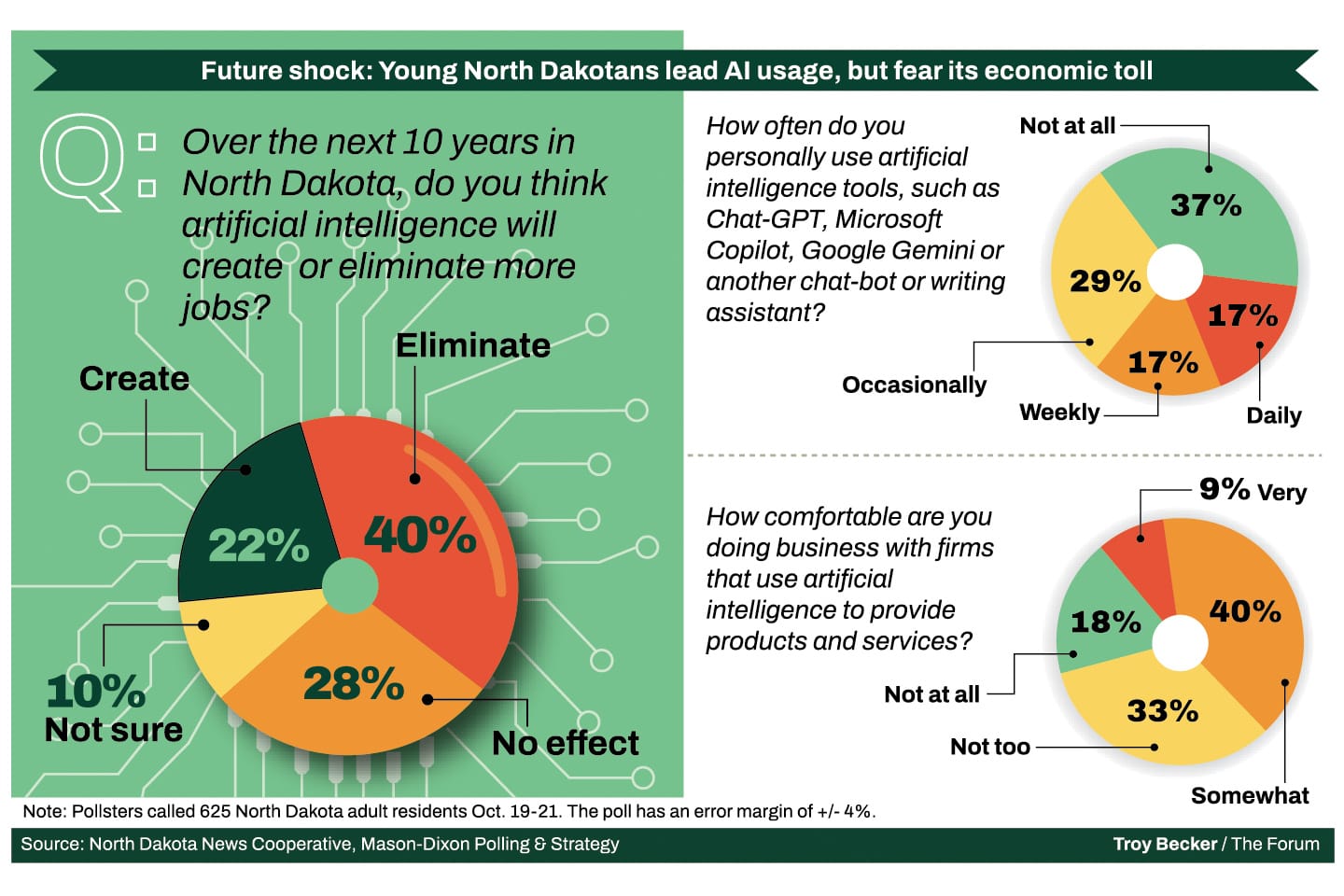
Combining all age groups, 40% say they feel AI will eliminate more jobs than it creates in the state, while 22% say it will create more than it eliminates. Another 28% say AI would have no impact on jobs and 10% are not sure, according to the poll commissioned by the North Dakota News Cooperative.
Andrea Pfennig, vice president of government affairs at the Greater North Dakota Chamber, noted the concerns but is optimistic because of conversations she’s had with employers across the state.
“For many, the immediate challenge is finding enough people to fill the jobs they already have,” Pfennig said. “AI offers an opportunity to support existing employees and help businesses grow despite persistent workforce shortages.”
Pfennig said employers report that AI could change the skill sets needed for many jobs, but that wouldn’t necessarily lead to reductions in numbers in the labor force.
Support independent ND journalism: Through Dec. 31, NewsMatch doubles all gifts up to $1,000.
“When I look at how North Dakota is growing, the demand for what I call skilled workers isn't going to end because of AI,” said State Representative Robin Weisz (R-Hurdsfield).
“In the next 10 to 20 years, I think the demand for skilled workers will still outpace the supply. Now what may be an issue, is how do we get our younger generation to want to go into those fields,” Weisz said.
The latest figures from the North Dakota Labor Market Information Center show over 13,500 full-time openings in the state, a 2.5% rise over September, and 6.2% higher than this time last year.
Those following the labor market note the statistics don’t capture all job openings, so the number of workers needed is actually somewhat higher.
“While AI may displace or transform some existing jobs, it also has the potential to improve productivity, help existing employees work more efficiently and create new jobs and industries,” said Cale Dunwoody, vice president of public policy at the Fargo-Moorhead-West Fargo Chamber of Commerce.
“This is particularly important in North Dakota, where we face one of the most severe workforce shortages in the nation, and emerging technologies could help businesses overcome workforce constraints,” Dunwoody said.
John Bitzan, Menard Family Director of the Sheila and Robert Challey Institute for Global Innovation and Growth and a professor of management at North Dakota State University, said whenever there is technological change, these kinds of fears over job loss arise.
“Yes, it will destroy certain types of jobs, but it will free up resources to create even better jobs and more opportunities for people,” Bitzan said.
“That doesn’t minimize the fact that some types of routine jobs will disappear, but it will also create more opportunities for people, and that’s just part of having a dynamic economy,” he said.
As far as current use of AI tools or chatbots, 17% of all age groups report daily use, 17% report weekly use, 29% occasional use and 37% report not using AI at all.
Asked about comfort levels with doing business with firms using AI to provide products and services, 51% say they are not too comfortable or not comfortable at all interacting with those businesses.
Some of the most striking numbers relate to the perception that AI poses an existential threat to human civilization.
Asked if they were concerned about AI eventually threatening humanity, 33% say they are very concerned, 33% somewhat concerned, 20% not too concerned and only 14% not concerned at all.
“It should probably give people some concern that about two-thirds of respondents are worried that AI is a threat to human civilization,” said State Representative Zachary Ista (D-Grand Forks). “That is incredibly concerning.”
The North Dakota Poll was conducted by Mason-Dixon Polling & Strategy, Inc. of Jacksonville, Florida, from Oct. 19 through Oct. 21, 2026. A total of 625 North Dakota adult residents were interviewed statewide by telephone as part of the survey. The poll has a margin of error of plus or minus 4 percentage points.
Among respondents, 40% identify as Republican, 39% as Independent and 21% as Democrat, with an even representation among age groups and genders.
Geographically, 25% are from Fargo and Cass County, 25% from other parts of eastern North Dakota, 19% from the Bismarck-Mandan region and 31% from western North Dakota.
The North Dakota Poll, sponsored by the North Dakota News Cooperative, is the only regular, nonpartisan statewide survey of eligible North Dakota voters and consumers.
Support independent ND journalism: Through Dec. 31, NewsMatch doubles all gifts up to $1,000.
The North Dakota News Cooperative is a nonprofit news organization providing reliable and independent reporting on issues and events that impact the lives of North Dakotans. The organization increases the public’s access to quality journalism and advances news literacy across the state.
Have a story idea? Send tips to michael@newscoopnd.org. Connect with us on X or Facebook.