Poll: Independents, Democrats lead in data center resistance
North Dakota sees political, geographic splits on data center expansion
Self-identified Independents and Democrats in North Dakota lead opposition to both traditional and hyperscale AI data centers, according to the latest North Dakota Poll.
Anti-data center sentiment also follows something of an east-west divide in the state, with the strongest opposition in the Fargo-Cass County region, particularly when it comes to potential electricity rate impacts of these facilities.
Asked whether they support or oppose traditional data centers, 55% of Independents and 54% of Democrats say they oppose these developments, while only 32% of Republicans oppose them, the poll, commissioned by the North Dakota News Cooperative, finds.
A total of 60% of Democrats and 57% of Independents statewide say data centers would impact electricity rates.
In Fargo-Cass County, opposition among all respondents is at 51%, while western North Dakota appeared slightly more welcoming with only 44% opposed.
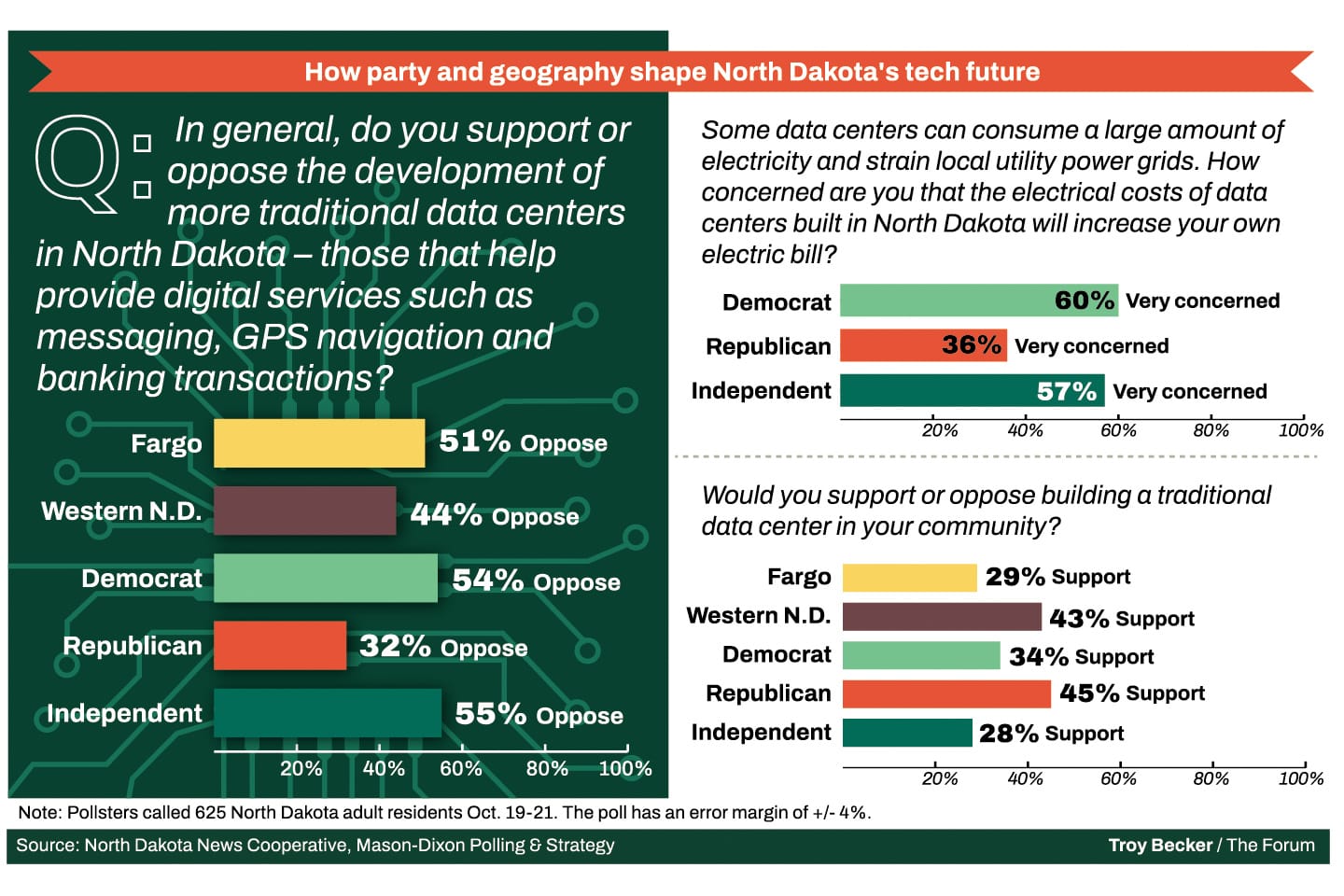
Traditional data centers provide digital services such as messaging, GPS navigation, banking transactions and storage for things like hospital records.
Party splits also come down to thoughts on whether state and federal officials can effectively regulate data centers and artificial intelligence development.
Only 19% of Democrats and 35% of Independents say the state could effectively regulate data centers, while 52% of Republicans say it could.
“I think there is a perception that the state's going to be permissive with allowing expansion of data centers, and so from the Republican point of view, that's seen as a good thing because Republicans want more data center expansion,” said John Bitzan, Menard Family Director of the Sheila and Robert Challey Institute for Global Innovation and Growth and a professor of management at North Dakota State University.
The numbers dropped across the board when it came to the question of whether the federal government can effectively regulate AI development, with only 13% of Democrats, 16% of Independents and 25% of Republicans believing it could.
Support independent ND journalism: Through Dec. 31, NewsMatch doubles all gifts up to $1,000.
The poll was conducted just before the most recent national midterm elections. Those NDNC reached out to for comment who reviewed the data pointed out that the numbers could come up differently depending on what party is in a majority position in Congress or holding the executive branch.
“I think that if you had different people in government, the answers might be very, very different,” Bitzan said.
Republicans were also more likely to find tax revenue from data centers to be an important factor in supporting them, with 68% of the group saying tax revenue was either very or somewhat important.
Republican use of AI either daily or weekly appears to be higher, with 43% claiming that frequency of use, compared to 34% of Democrats and only 26% of Independents.
On the concern related to job losses from AI, Democrats lead the way with 46% fearing it would eliminate more jobs than it would create in the state, while 41% of Independents feel the same.
“Republicans seem to be more comfortable with (AI and data centers), and to view it as more beneficial than Democrats do,” said Robert Mayo, an economist and researcher at North Dakota State University’s Sheila and Robert Challey Institute for Global Innovation and Growth.
“Democrats seem to be more concerned about the harms and less optimistic about the benefits,” he added.
State Sen. Kathy Hogan (D-Fargo) said the Independent voice “was quite distinct” and that it would be interesting to find out more about this group of potential voters.
State Rep. Robin Weisz had a similar reaction.
“I’ve always wondered, in North Dakota, who really are the Independents,” Weisz said. “I’ll be honest, I normally don’t meet many. It’s usually rabid Republicans or pretty rabid Democrats.”
Weisz said that group was hard to pin down and could range from people who don’t care much about politics to far ends of the political spectrum including libertarians and socialists.
Besides the party and geographic splits, most who viewed the poll data thought it was interesting that there were only minor differences on most questions when age and gender were factored in.
The North Dakota Poll was conducted by Mason-Dixon Polling & Strategy, Inc. of Jacksonville, Florida, from Oct. 19 through Oct. 21, 2026. A total of 625 North Dakota adult residents were interviewed statewide by telephone as part of the survey. The poll has a margin of error of plus or minus 4 percentage points.
Among respondents, 40% identify as Republican, 39% as Independent and 21% as Democrat, with an even representation among age groups and genders.
Geographically, 25% are from Fargo and Cass County, 25% from other parts of eastern North Dakota, 19% from the Bismarck-Mandan region and 31% from western North Dakota.
The North Dakota Poll, sponsored by the North Dakota News Cooperative, is the only regular, nonpartisan statewide survey of eligible North Dakota voters and consumers.
Support independent ND journalism: Through Dec. 31, NewsMatch doubles all gifts up to $1,000.
The North Dakota News Cooperative is a nonprofit news organization providing reliable and independent reporting on issues and events that impact the lives of North Dakotans. The organization increases the public’s access to quality journalism and advances news literacy across the state.
Have a story idea? Send tips to michael@newscoopnd.org. Connect with us on X or Facebook.